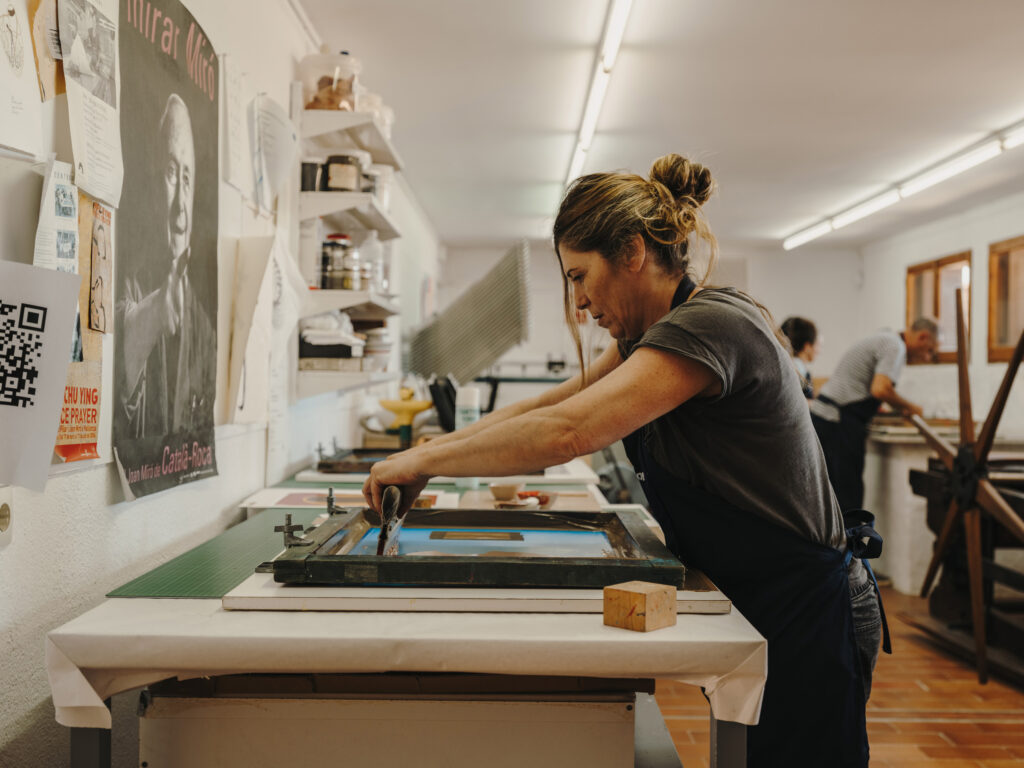


Joan Miró's Printmaking Workshops
- Photopolymer Workshop - Engraving with polymer plates. Hand-drawn and digital positives as creative supports.
Given by
- Ramón Freire
Dates
- August 31st d'agost to September 5th 2026
Timetable
- From Monday to Friday 9 a.m – 3p.m.
- Saturday 10 a.m. – 2 p.m.
Place
- Universitat de Mallorca - ADEMA
- (C. del Gremi de Passamaners, 11, polígon de Son Rossinyol)
Maximum no. of students
- 10
Price
- 260€
Applications
Contact
T3/2026 – Photopolymer Workshop (full)
Engraving with polymer plates. Hand-drawn and digital positives as creative supports. Given by Ramón Freire
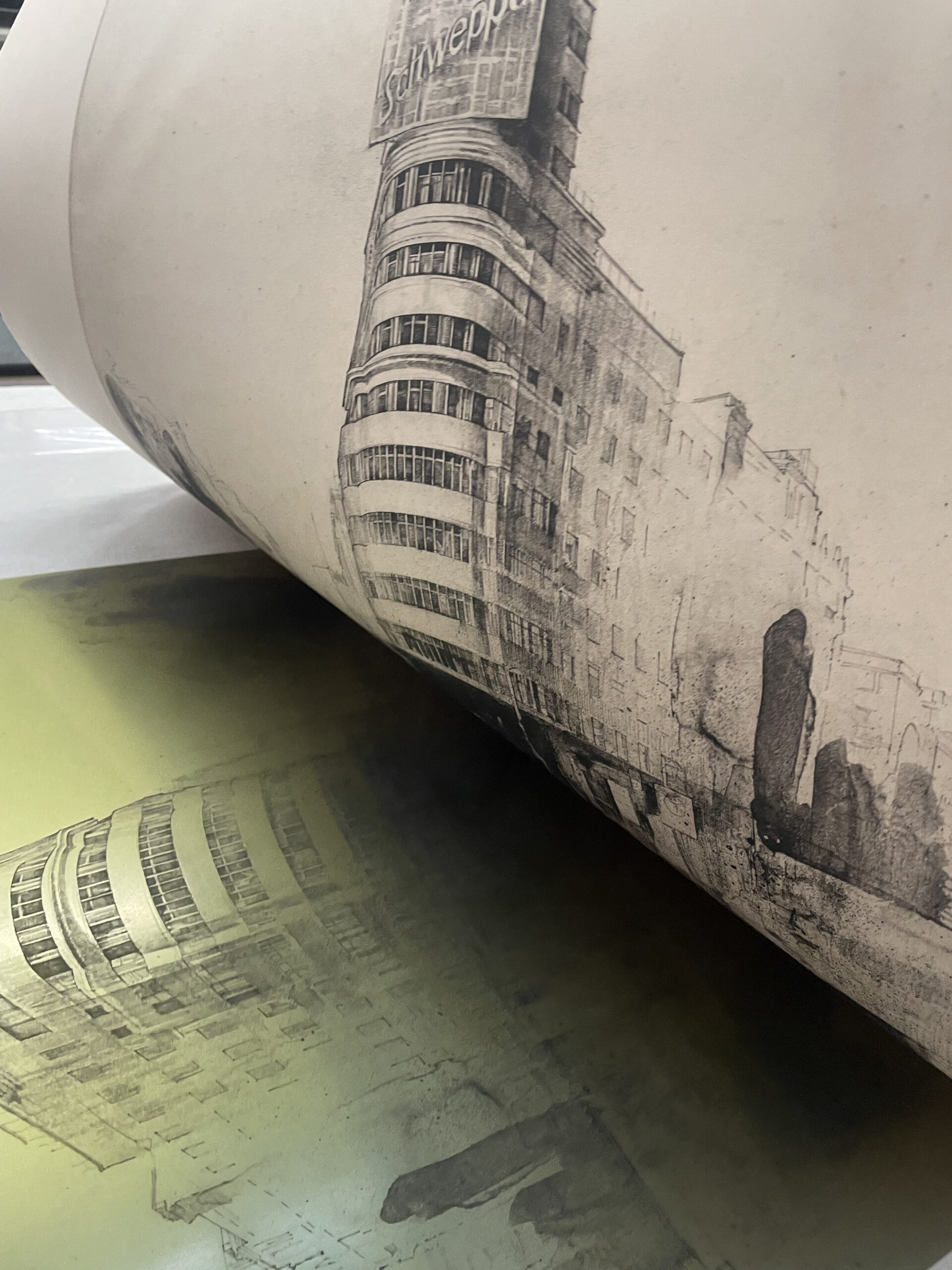
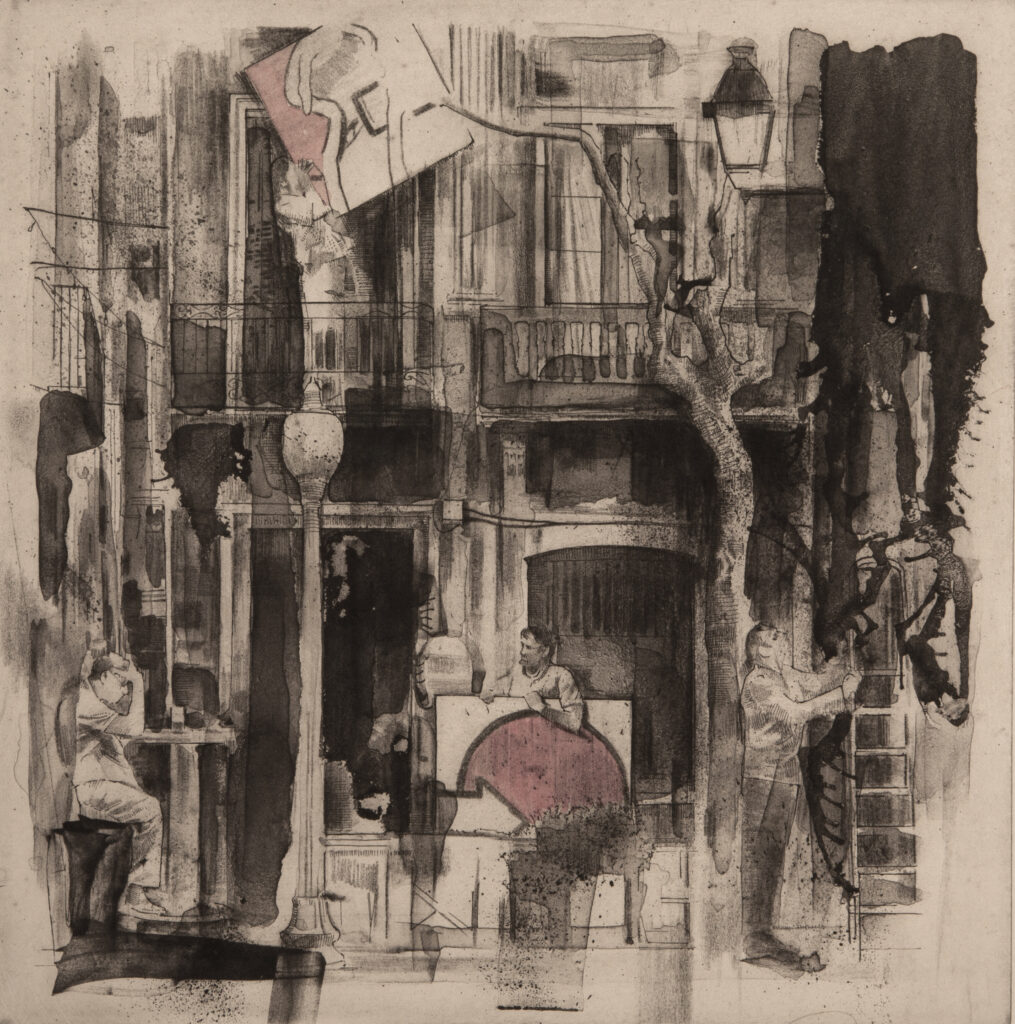
Photopolymer plate engraving is a modern and versatile technique that combines the precision of the photographic process with the beauty of traditional engraving, allowing artists and designers to create detailed, high-quality prints with greater ease and less environmental impact.
The photopolymer plate as a matrix is a new material for making an engraving. Through a photomechanical process we will be introduced to this new procedure, with multiple aesthetic-plastic possibilities and where the creative act becomes the most important.
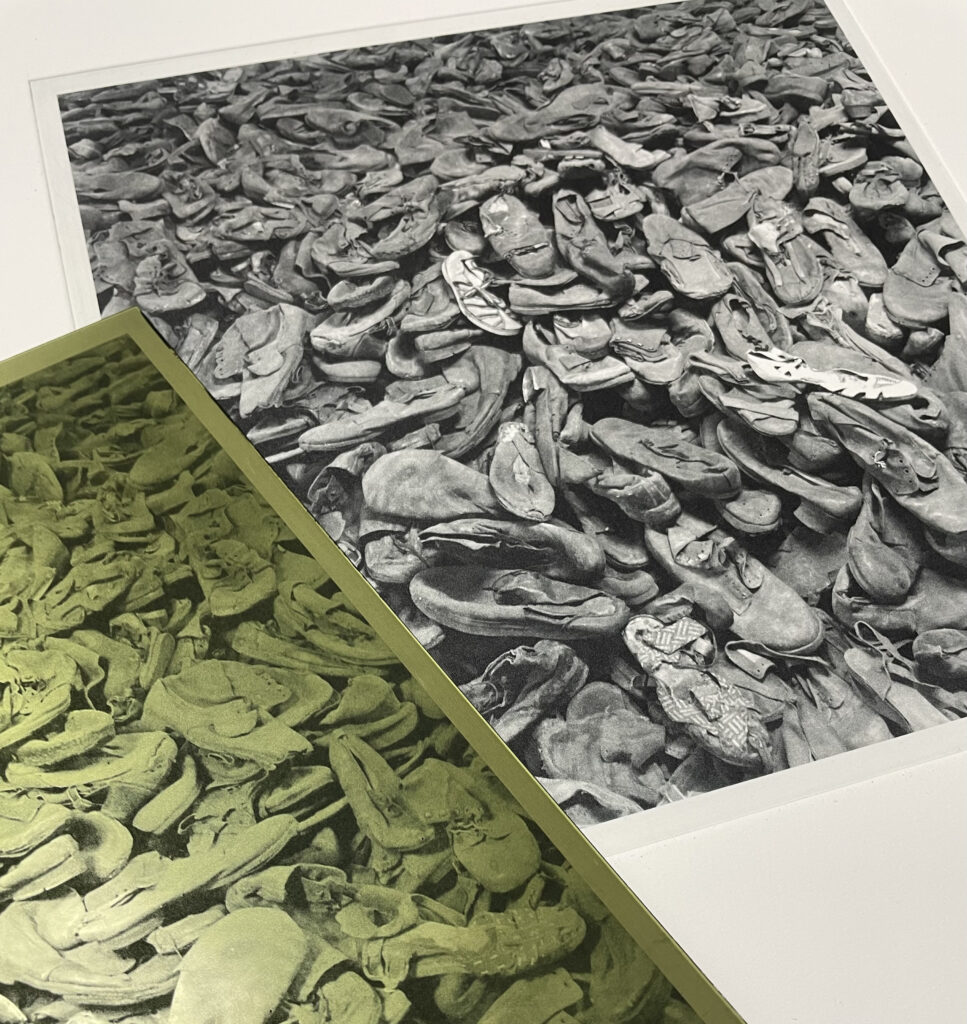
Also known as photogravure, it is a printing technique that uses photopolymer matrices to create images. It allows you to reproduce photographic images, as well as autographic (original drawings), with a multitude of details. In the same way, you can obtain an enormous tonal spectrum through different drawing processes such as washes, pencil strokes, bars, waxes, markers, etc. It is capable of recording nuances and subtleties that are highly difficult to reproduce with any of the traditional engraving processes.
Knowledge and adequate control of all the parameters involved in this process is essential for its proper use and, therefore, the achievement of optimal results. Without a doubt, we are facing the most important tonal scale graphic process in the history of engraving.
OBJECTIVES
● Show the photopolymer plate as a matrix for engraving.
● Know the fundamental aspects of making an engraving using a photopolymer plate.
● Know the aesthetic and plastic possibilities that this procedure offers.
● Teach the autographic positive and the digital positive as creative supports.
● Deepen concepts related to density, exposure and photomechanical media.
● Create photopolymer plates where creativity is the common denominator.
PROGRAMME
● Introduction to engraving using photopolymer plates.
● The photopolymer plate. General considerations.
● Types of positives. Exposure source. Control and analysis of the parameters involved in the processing of the matrix. The need for the screen pattern. The screen; composition and systems.
● The autographic positive. Supports. Construction of the positive. Materials. Processing of the matrix.
● The digital positive. Supports. Construction of the positive. Output peripherals. Image adjustments prior to making the positive. Processing of the matrix.
● Inking and printing process of the matrix.
Ramón J. Freire Santa Cruz. Écija, Sevilla
Professor of Engraving at the Faculty of Fine Arts of Cuenca, Department of Art, Drawing Area, University of Castilla-La Mancha. Doctor of Fine Arts with European mention from the University of Granada. Doctoral candidate from the Faculty of Humanities and History of Art of the University of Jyväskylä (Finland).
Director of the Master’s Degree in Engraving and Graphic Design of the Royal Mint and Stamp Office. FNMT-UCLM. Coordinator of the Collection of Graphic Works and the Collection of Juana Mordó Graphic Works Funds of the Faculty of Fine Arts of the UCLM.
In the academic field, he is immersed in the realization of different research projects, in relation to artistic practices; specifically: engraving, photography, photomechanical procedures, new digital tools for the constitution of matrices and the search for engraving procedures that are less harmful to humans and nature. He is also immersed in the development and creation of inks from natural products, specifically the Garnacha ink grape, through which he leads several research projects articulated through UCLM and private companies.
Co-founder and president of the publishing project La CajaGrafa, he combines his activity as an artist with teaching and research. He has received numerous grants from different national and international centers and institutions for his research activity, which for years has been developing on engraving and new less toxic procedures.
He has held numerous workshops, courses and talks, nationally and internationally, on graphic processes such as engraving using photopolymer plates, lithography with polyester plates, cyanotype or different engraving techniques.
He is a research member of the Children’s Literature and Literary Education Research Group (LIEL), which leads an international meeting of researchers dedicated to the study, compilation, classification, analysis and dissemination of popular literature of children’s tradition. At present, this group is developing a research project funded by the Ministry of Education, Culture and Sports of the Junta de Comunitats de Castilla-La Mancha, called “Corpus de literatura popular de tradición infantil de Castilla-La Mancha” (ref. SBPLY/17/180501/000453), which has among its objectives the creation of a website where literary compositions of oral tradition specifically for children and young people from this region are collected, in text and audiovisual format.
Since 2009 he has been a member of the HUM328 research group, an artistic research group, at the University of Granada, which carries out research on photomechanical procedures applied to relief engraving, specifically using photopolymer plates. To date, he has held several workshops, master classes, conferences, presentations and specialist courses dedicated to these procedures, offering a wide study of the process. In 2008, the Japanese multinational Toyobo S.L signed a collaboration agreement for the development and work of this research, financed this project and acquired the rights to its results.
As an artist, he has participated in numerous collective and individual exhibitions at a national and international level, and has participated in different artistic projects related to design, drawing, sculpture, painting and engraving. He has also worked closely on the production of graphic work editions with the Taller d’Edició La Zúa (Cuenca), Finaestampa Editora (Granada) and his own workshop.
His works are present in public and private centers and organizations, including Huafan University, Taipei, (Taiwan); Corkprintmaker (Ireland); Honor Meyers Collegue, Ohio (USA); Jyväskylä Centre of Printmaking (Finland); HIAP (Helsinki); CAAC Collection, University of Castilla-La Mancha; Department of Drawing, University of Granada; Contemporary Art Collection of the University of Granada; School of Arts and Crafts of Seville; Chilean Pavilion, Urbino City Council (Italy); Antonio Pérez Foundation Contemporary Art Center, Cuenca; CIEC Foundation, International Center for Contemporary Print, Betanzos (Galicia); University of Castilla-La Mancha; Vilnius Academy of Fine Arts (Lithuania); Poznan Academy of Fine Arts (Poland); ISA, Havana (Cuba), and Łódź Academy of Humanities and Economics (Poland), among others.
This workshop will be carried out in collaboration with Universidad de Mallorca – ADEMA.