

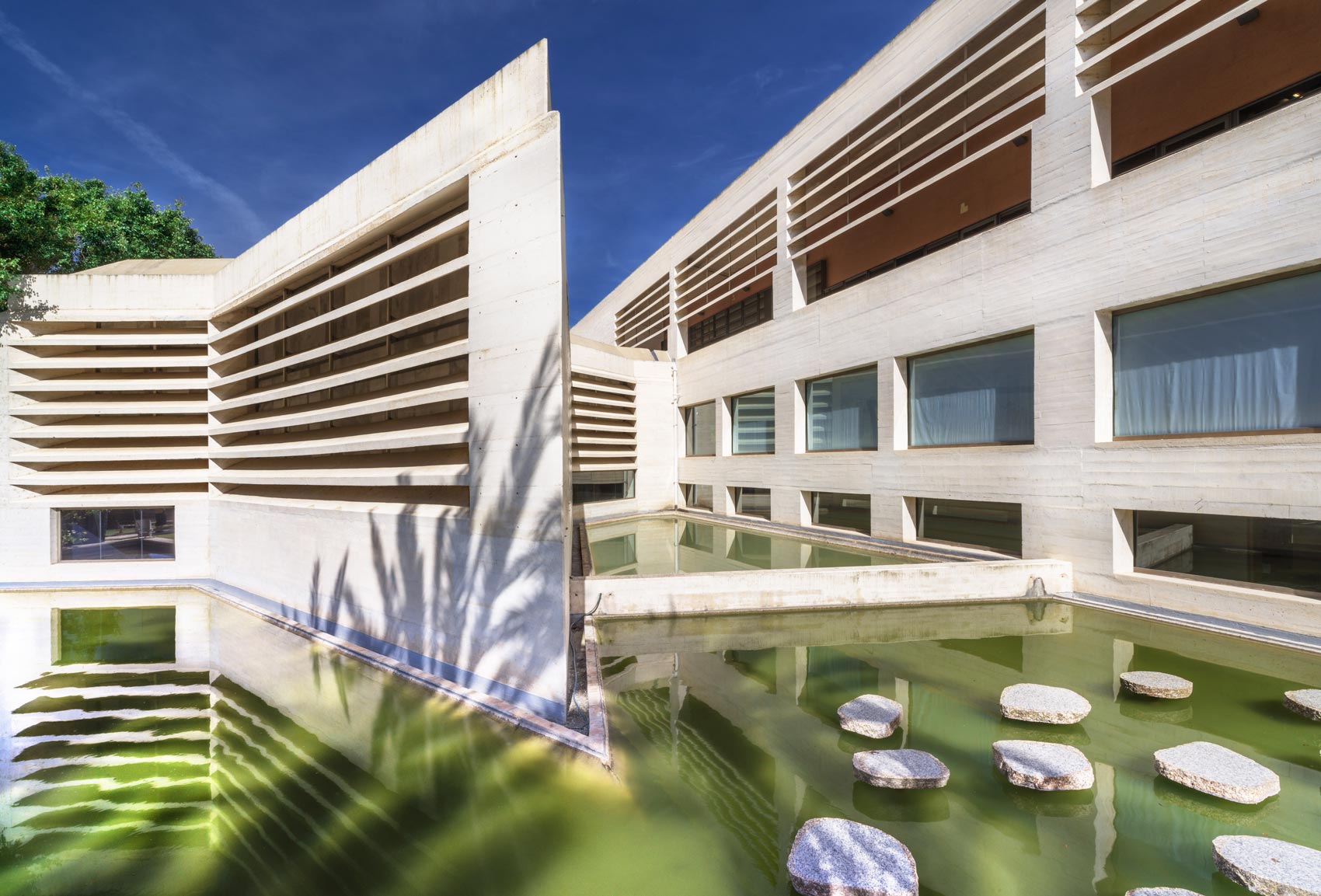
Moneo building
Auditori
L'edifici Moneo, seu actual de la Miró Mallorca Fundació, es va inaugurar el 1992. Projectat per l'arquitecte Rafael Moneo és el resultat de la donació de Pilar Juncosa, vídua de Miró, a la Ciutat de Palma.
-
Exhibition space
- Auditori
-
Dates
- 15 April — 6 September 2026
-
Inauguration
- 15 April 2026
- 19:00
Claudio Zulian, “La montagna incantata”
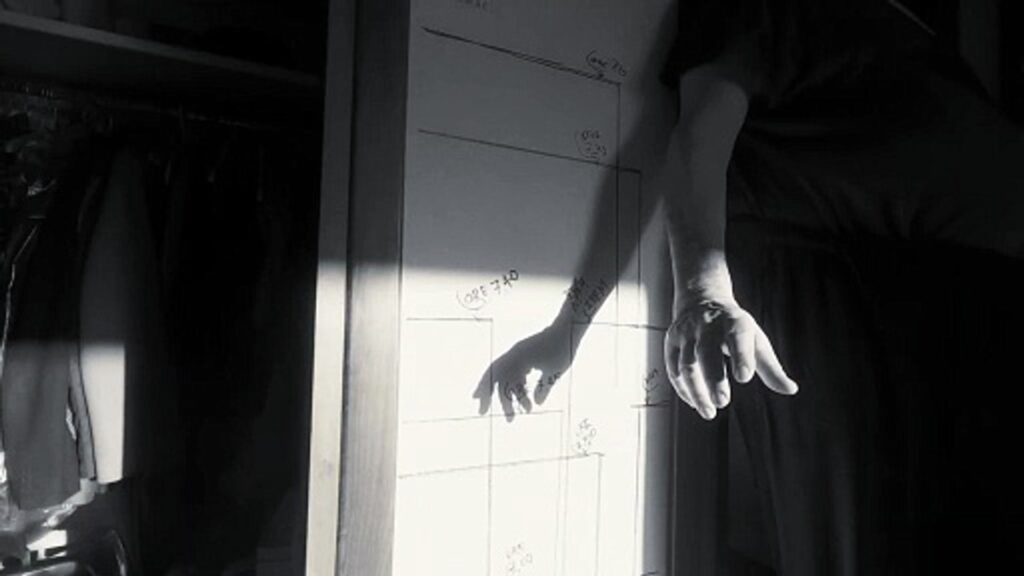
Claudio Zulian is a film director, video artist, musician and writer. His work, mainly in the fields of film, video installations and theatre, is characterised by a sensitivity towards social and political issues and a search for specificity in each medium he works with.
Polyphonic portraits: rewriting the present
Polyphony is not only the simultaneous existence of several voices but also the ability to hear these voices at the same time without reducing them to a single one. It implies a kind of attention that embraces simultaneity, disagreement and layering as conditions of meaning. In Claudio Zulian’s work, this relational logic permeates the image, sound and narrative, as well as the very act of working with others.
Before establishing himself as a filmmaker and visual artist, his musical training taught him that listening, rhythm and the relationship between registers were fundamental skills. From that initial experience remains a conception of creation as a shared space, in which each voice maintains its uniqueness and the whole is articulated not through hierarchy but through connections.
Translated into cinema and artistic practice, this sensibility takes shape in projects conceived as open compositions, configured by times, spaces, presences and testimonies that coexist. The audiovisual works presented in this exhibition—from L’Avenir (2004) and A través del Carmel (2006) to A lo mejor (2007) and La montaña mágica (2023)—create a space where memories, life stories and various ways of inhabiting the world all converge.
Far from functioning as illustrations of a prior discourse, these projects construct narrative from situated experience, touching on the real and concrete whilst maintaining a constant tension between the individual and the collective. The political dimension of Zulian’s work can be seen in his attention to everyday life: small gestures, rhythms of life, ways of working and movements. His films address ongoing processes of transformation and they see memory as a living territory that’s constantly being rewritten.
From a cinematographic point of view, his use of long takes and attention to duration reinforce an ethic of continuity: time is not fragmented and the experience unfolds without artificial interruptions. The camera accompanies processes of change (be they life-related, urban, social or symbolic) and allows the everyday rhythms, community rituals and different ways of relating to space to emerge.
Taken as a whole, Zulian’s work constitutes an experience of shared attention where individual and communal dimensions enter into dialogue and where polyphony becomes a way of thinking about relationships and situating ourselves in the present.
Sofia Moisés Pizà
S’Ubac: voice as a space of tension
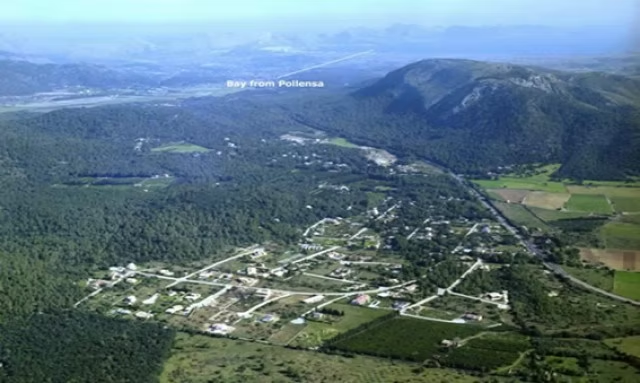
The installation S’Ubac, conceived as a result of intensive research in the municipality of Sa Pobla more than twenty years ago, is a key work in Claudio Zulian’s career. First presented in 2000, the piece has been reactivated within a new spatial and temporal context that transforms the conditions of perception and reception.
This is a poetic, political work that creates an acoustic architecture using fragments of oral testimonies from a specific community: stories from the past, popular songs and chants linked to working in the fields, soundscapes and the traditional rhythms of the zambomba drum. Through repetition, serialisation and displacement, the work provides a complex image of a place where memory, identity and everyday experience are all intertwined, and where long-established ways of life and present-day conditions encounter one another with no fixed hierarchy.
The musical treatment of the voices preserves the meaning of the words and the songs, accentuating their internal rhythms, timbres and intonations. The sound installation, initially conceived for the Crestatx forest and reconfigured for the gardens of the Fundació Miró, connects two different contexts and brings out new shifts in meaning.
The buzzing of the zambomba creates a rhythmic fabric that is reminiscent of both musical traditions and natural sounds; water mills evoke slow, persistent cycles whilst contemporary domestic noises permeate the reading of the gravestones in the Sa Pobla cemetery, read in the first person as if they were messages left on an answering machine.
The space is therefore constructed as an auditory dramatisation of temporal and social tensions. S’Ubac provides a listening experience that allows us to think about ourselves historically, to interpret the present in all its density and to recognise, in the voices that narrate and sing, the continuities and fractures that shape collective memory.
Sofia Moisés Pizà
Audiovisuals
L’AVENIR, 2004
Film and video installation.
Format: 16:9
Duration: 23 min. B/W
Sponsorship: Culture Commune – Scène Nationale du Bassin minier du Pas-de-Calais, with Lille 2004 – European Capital of Culture, the European Community (European Social Fund), the Ministry of Culture (DRAC Nord-Pas de Calais), the Regional Council of Nord-Pas de Calais, the General Council of Pas-de-Calais and the Communauté d’agglomération de Lens/Liévin
Awards:
– Silver Dove Leipzig Documentary and Animated Film Festival 2005
– Ecumenical Award Leipzig Documentary and Animated Film Festival 2005
– Best Documentary Short Film Award Viña del Mar Digital Film Festival 2006
– Second Prize Best Documentary Mediterranean Film Festival, Siroki Brijeg, 2007
– Special Jury Mention International Film and Digital Arts Festival, Girona 2007
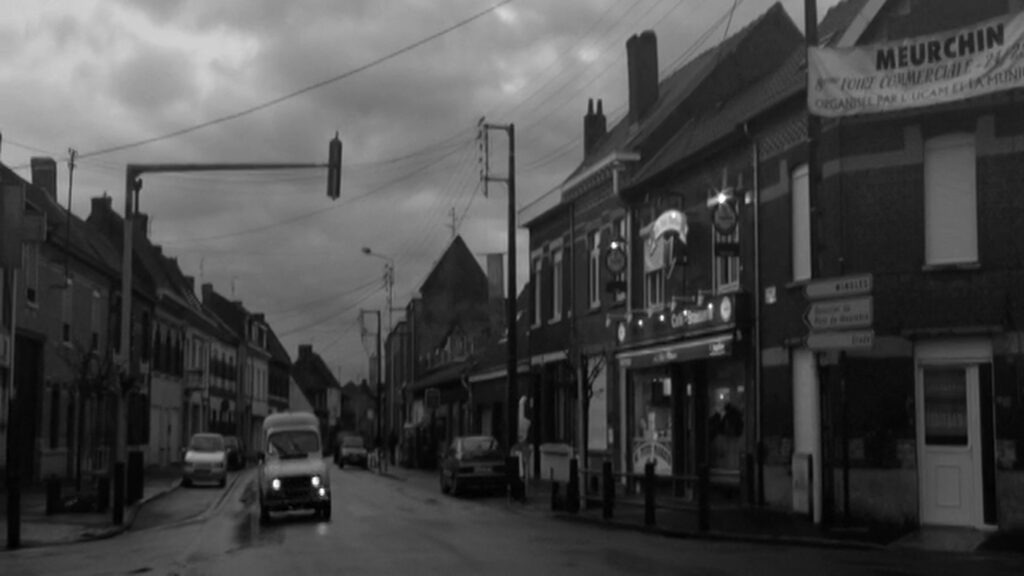
L’Avenir was filmed in the village of Meurchin (Lille), in north-western France. This region experienced a period of great economic prosperity due to the presence of coal mines, but from the 1960s onwards it suffered an inexorable industrial decline. In countless encounters with the residents—who were unfailingly kind—concern for the future—personal, for the village and for the region—emerged as the core around which many images and stories gravitated. The series of sequence shots that make up L’Avenir portrays some of the town’s inhabitants inside their homes, at work or at leisure, while their voices-over wonder about their own lives and their future.
A TRAVÉS DEL CARMEL, 2006
Video installation and feature-length documentary
Format: 16:9
Duration: 92 min.
Production: Acteon for Televisió de Catalunya
Collaboration: Institut Català d’Empreses Culturals de la Generalitat de Catalunya.
Awards:
– National Film Award from the Generalitat de Catalunya
– City of Barcelona Award from the Barcelona City Council
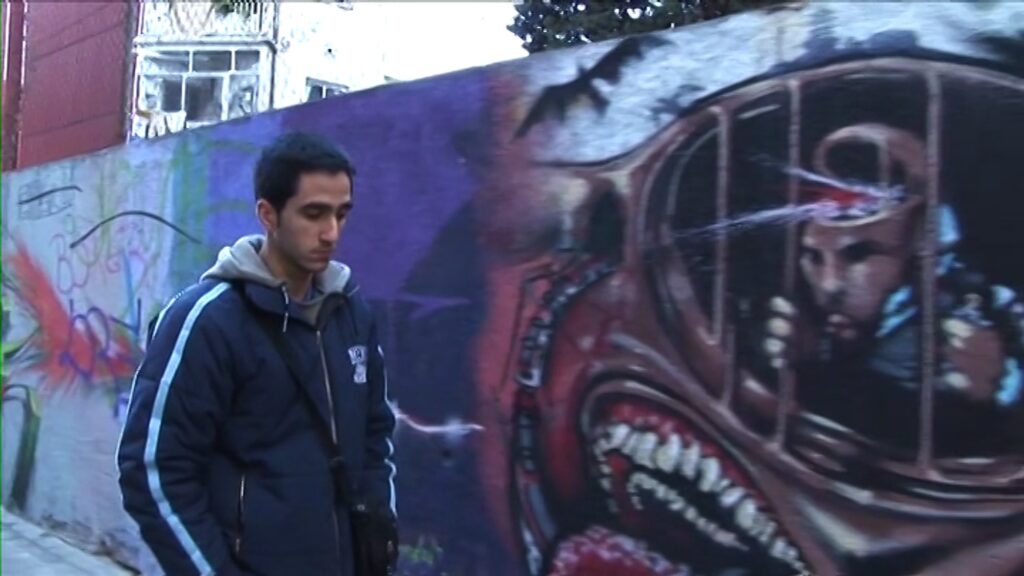
Claudio Zulian and his team worked for a year in Barcelona’s Carmel neighbourhood, a working-class neighbourhood perched on a hill in the city, built by immigrants in the 1950s and 1960s and with a long history of neighbourhood struggles – thanks to which it is now a dignified place. Nearly forty groups and fifteen individuals, totalling more than a hundred people, participated in the conception and filming of this 92-minute sequence shot. The result was an audiovisual record of almost two hours of neighbourhood life filmed without interruption throughout the day on 10 February 2006, from 4 to 6 p.m. The residents opened their homes, workshops and daily occupations to us and explained things about a typical day – where the origin and future of all life is summed up.
A LO MEJOR, 2007
Video installation and film
Format: 16:9
Duration: 13 min.
Production: Espai d’Art Contemporani de Castelló for the exhibition Nuestra hospitalidad (Our Hospitality), curated by Rodrigo Alonso.
Espacio de Arte Contemporáneo de Castellón (EACC)
Collaboration: Favius Buzatoaia, Maria Panait, Bebe Panait, Claudia Popescu, Mihai Gagiu, Corina Gheorghe. Spanish voiceovers: Lia Opris, Ion Adrian Alani.
Awards:
– Best Creative Documentary at Canarias Mediafest 2008
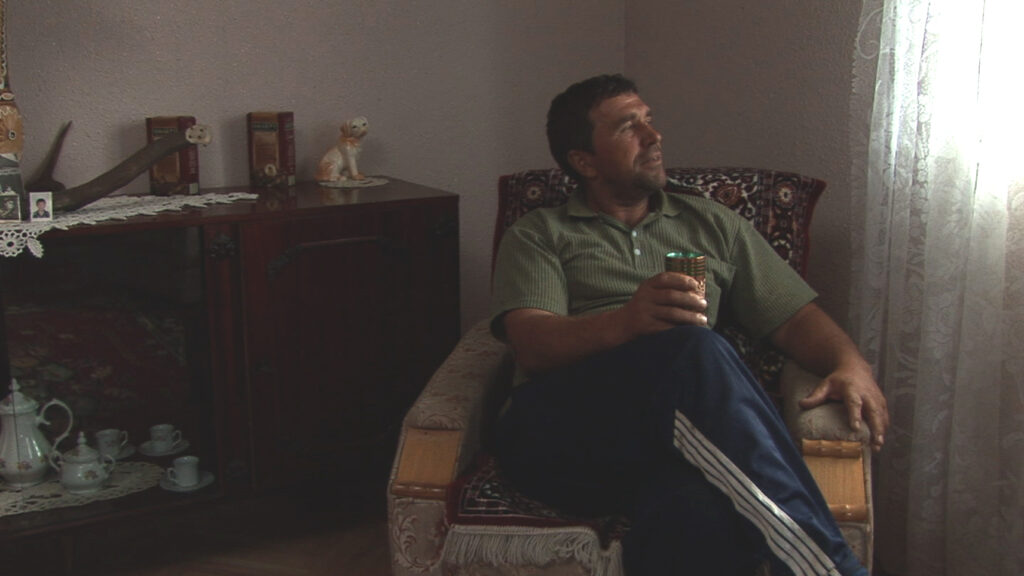
Claudio Zulian worked for several months with a group of Romanian immigrants in Castelló de la Plana. However, instead of portraying the city from the immigrants’ perspective, the artist chose to capture the fantasies of their families and friends, who had remained in Romania and therefore only knew Castelló from the stories and images sent from Spain. In the testimonies of these family members and friends, the city takes on a fantastical appearance; human and working relationships, on the other hand, are very concrete.
The original voices in Romanian have been dubbed by a Romanian woman and man who have been living in Spain for some time. The accent is the journey of language.
LA MONTAGNA INCANTATA, 2023
Feature-length documentary and expanded cinema
Format: 16:9, B/W
Duration: 102 min
Production: Acteon
Co-production: Jolefilm (Italy)
Awards:
-Director’s Award ‘Testimony of our time’ at the Campodarsego Culture Gala 2023
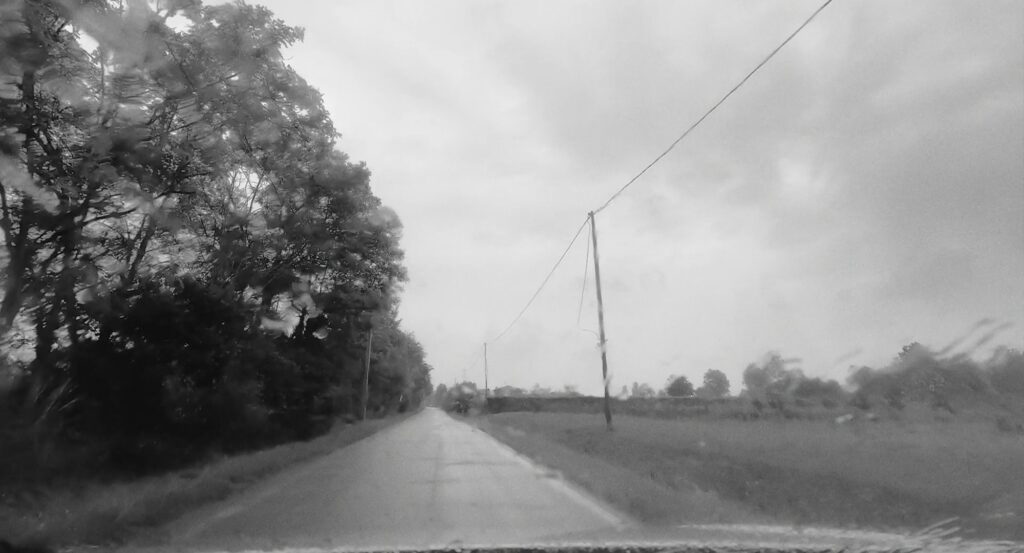
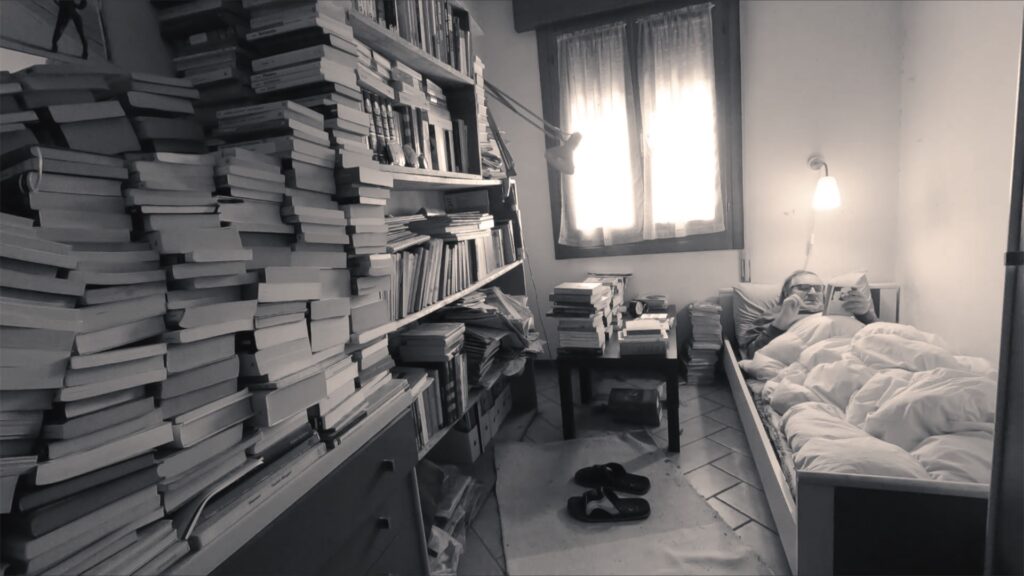
In Thomas Mann’s The Magic Mountain, patients and medical staff live together in a luxury sanatorium, isolated from the world. The book, in fact, builds a metaphor for a sick era. Inspired by reading it, I revisited some images I recorded during the pandemic and lockdown of 2020. A few years have passed since then, and now, empty cities and people isolated in their homes can be seen, in the manner of Thomas Mann, as an X-ray of our current daily life – with its secret scaffolding and intangible illnesses. The Magic Mountain is an ensemble film in which twenty people from a corner of Veneto – once a poor agricultural land, now a rich industrial region – in north-eastern Italy explore their own lives and surroundings in those strange times. Suspended in emptiness and silence, poor, rich, natives and immigrants, women, men, children and the elderly question themselves about the hopes and difficulties of our existence.
CONSTEL.LACIÓ PORTABELLA, 2024
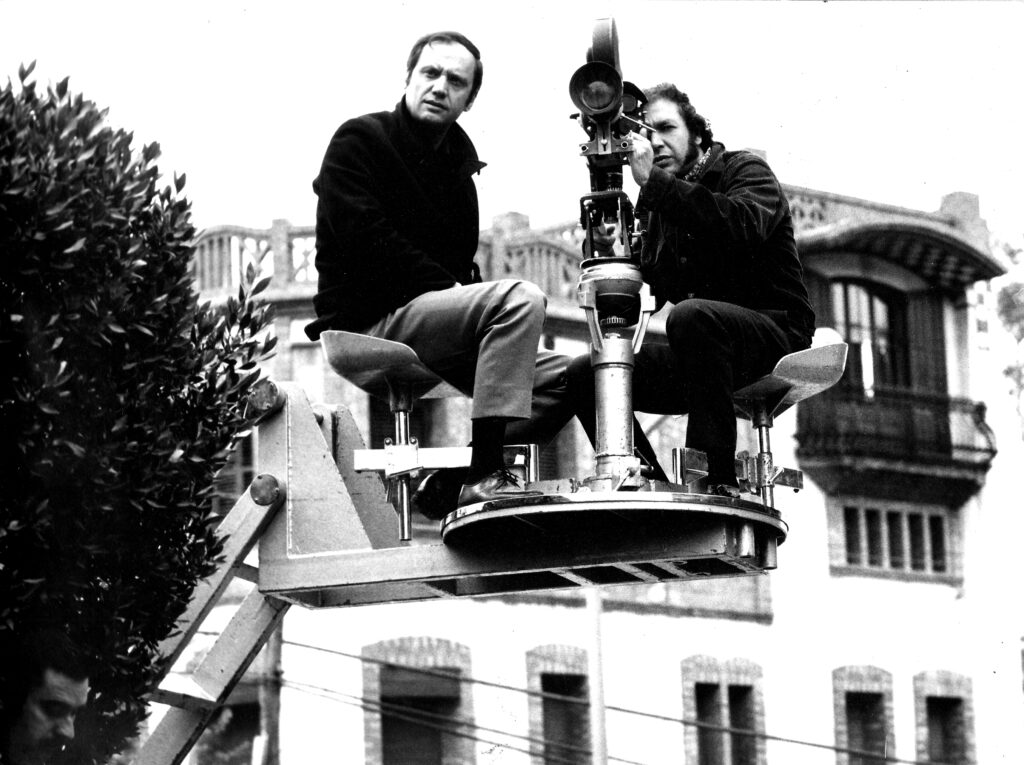
Parallel activity: Documentary and talk between Jordi Ballò and Claudio Zulian.
- When: May 21st – 8 p.m.
- Where: Fundació Pilar i Joan Miró a Mallorca – Auditorium
Duration: 88’
Version: Original version with subtitles
Production: Acteon
Co-production: 3Cat, RTVE, La Charito Films, Eddie Saeta, Caixaforum +
Collaborators: Catalan Institute of Cultural Industries (ICIC) of the Generalitat de Catalunya, Films 59, Mercury Films, ICAA, Institut Ramón Llull, Xarxa Audiovisual Local, Antaviana.
Award:
-Audience Award at the Memorimage Festival in Reus, 2025
Festivals:
-Venice Film Festival – Competition 2024
-Valladolid Film Festival – Seminci 2024
-Buenos Aires International Film Festival – BAFICI 2025
-Festival D’A, Barcelona 2025
-Sao Paulo Film Festival 2025
This is the first documentary dedicated to the life and work of Pere Portabella (Barcelona, 1927), made by Claudio Zulian (A través del Carmel, Born) using excerpts from films, talks, lectures and interviews with Portabella himself in different media throughout his career as a filmmaker and politician. Framing it all are reflections from critics, film directors and historians who have been involved with his art and participated in his works. Thanks to Jordi Ballò, Jonathan Rosenbaum and Luis E. Parés, among others, we immerse ourselves in the challenges behind the creative endeavours of a total artist.
Contact
Collections
Fundació Miró Mallorca
Carrer de Saridakis, 29
07015 Palma
Tel. +34 971 70 14 20
exposicions@miromallorca.com
Biographies
Claudio Zulian: He was born in Italy (Campodarsego, Padua) in 1965 and currently resides in Barcelona, Spain. He holds a PhD in Aesthetics, Science and Technology of the Arts from the University of Paris-Saint Denis (France). He is the author of a multifaceted body of work spanning the visual and sound arts, film, television, music, theatre and literature. A significant part of his work is characterised by a sensitivity to social and political issues and the search for specificity in each medium in which he works. He has taught courses, workshops and lectures at various universities and cultural and artistic centres and writes regularly for magazines and newspapers.
He has had solo exhibitions at centres and museums such as the Centro Galego de Arte Contemporáneo, Caixafòrum Barcelona and Jeu de Paume (Paris), among others.
His featured films and documentaries have been screened and won awards at international festivals in New York, Sydney, Singapore, Leipzig and Milan. He won the City of Barcelona Award and the National Award of Catalonia for A través del Carmel (2010), and his filmography includes works such as Sin Miedo (2017), No nacimos refugiados (2020), La montaña mágica (2023), and Constelación Portabella (2024), which had its world premiere at the Venice Film Festival.
Pere Portabella: A great Spanish filmmaker: his films No compteu amb els dits, Nocturno 29, Vampir–cuadecuc, Umbracle, Pont de Varsòvia and El silencio antes de Bach have been fundamental references in an influential and alternative film culture. Portabella has also been a very important producer: we owe him Marco Ferreri’s El cochecito and Luis Buñuel’s Viridiana. He has also been a very prominent politician: he was elected senator of the Spanish Constituent Assembly and his signature is on the Spanish Constitution of 1978
